Friday, July 9, 2010

Sunday in Sevagram

This past Sunday, July 4th, we had our weekly day off. Like the previous Sunday, instead of just shopping in Gadchiroli, the American research interns used the opportunity to take a field trip to Sevagram. SEARCH was allowing us to take a field trip without an Indian chaperone, other than our driver. To celebrate July 4th we piled into a van and took the four-hour ride to Gandhi's ashram.

I read before coming to SEARCH that Dr. Abhay Bang was raised in Sevagram, where Mahatma Gandhi's used to live, work, and pray. Although Gandhi was already dead by the time Dr. Bang was born, his father had met Gandhi and it changed the course of his life as an economics professor. Sevagram means "village of service." It is also the home of the first rural medical college in India. Drs. Abhay and Rani Bang have modeled SEARCH after Sevagram and have chosen to follow the Gandhian principles of simplicity and living alongside the poor.

Now, I have to admit, I do not know that much about Gandhi. I know he lived in India. I know he led civil disobedience demonstrations and he is known for his approach of non-violence. I know that he also fasted during times of upheaval and protest.

I am sad to admit that I did not know he lived from 1869-1948, that he was married by the age of 13, that he lived in South Africa as an expatriate for nearly two decades, that he played a major role in the struggle for India's independence from Britain, and upon gaining independence he fought to end poverty, end the caste system, and to inspire economic self-reliance, his wife died while he was imprisoned, and that he was assassinated. All of this I learned during our field trip. To truly understand Gandhi I would probably have to read a lot of philosophy and history books, or I can watch the 1982 Academy Award winning movie, Gandhi.

The car ride itself was uneventful and I spent most of it staring out the window and trying to nap. We made one stop at a gas station. The only way that I can describe this rest stop is that it looked like a simple gas station, but then when you went around back there was a whole bazaar of snack stands. The driver let us out and we went crazy picking up cookies, candies, and munchies. We also had the opportunity to use the bathroom. A long time ago I learned my lesson about using the bathroom when you had the opportunity to do so. (Once, as a college freshman, my lacrosse team had to stop on the side of the highway because I drank so much water during our away game, partially because I was sick with a cough at the time, and I had failed to use the bathroom before leaving. I absolutely could not hold it for the two hours that remained in our drive back to Brandeis). On our way to Sevagram, I did not have to go that bad until I started worrying about what would happen if I did need to go. Therefore, I thought it would best if I made myself use the bathroom at the gas station. All I have to say is American gas station bathroom + multiple squat toilets = you try to imagine it. I told myself it would only be 30 seconds. I ran in, went into the closest stall, didn't even close the door all the way, dropped my pants, and was out of there in less than a minute. I doused my hands with water and hand sanitizer afterwards.

After that lovely story, here are some lovely pictures:


On the way to Gandhi's ashram, we actually stopped at a smaller ashram first. These are the grounds of Brahma Vidya Mandir. It is an ashram founded in 1959 by Vinoba Bhave (Vinobaji) for women who want to live a life of deep spirituality, organic farming and other productive manual labor, voluntary poverty, and service.

We arrived during the noon prayer (in the background). We were warmly welcomed after the prayer was over. Most of the members of the ashram spoke English. According to the pamphlets we received, all decisions about the activities and arrangements of the ashram are decided unanimously, which is thought to strengthen the community.

The members of the ashram lined up at the temple. According to the pamphlet, the ashram does not attach itself to any country or any religion. They welcome everyone. Now men live there too. There was one Western-looking young lady living there. This reminded me very much of the book Eat, Pray, Love.

A view of open-air walls of the temple.

Here are the grounds at Sevagram. Gandhi arrived in Sevagram in 1936 at the age of 67. In India, Gandhi is affectionately referred to as Bapu, which means "father."

A photo taken on the back patio of Gandhi's hut. Unfortunately I did not take many pictures of the huts and buildings straight on; I mostly took pictures of the informative boards that were written in both Marathi and English. When this hut was built, Gandhi mandated that it did not cost more than 500 rupees (about $12 in today's world) and that it use local materials that would be available to everyone. He wanted to model living simply and using the resources that one has at their disposal without getting all fancy.

Another view of the peaceful grounds in Sevagram, Gandhi's ashram.

A monument in Sevagram. The translation is roughly "In this village, we hope to see a world that is healthy and without disease."

A beautiful photo of the sunset, taken during our four-hour drive back to Gadchiroli.

A photo of the Indian flags on the dashboard inside the van.
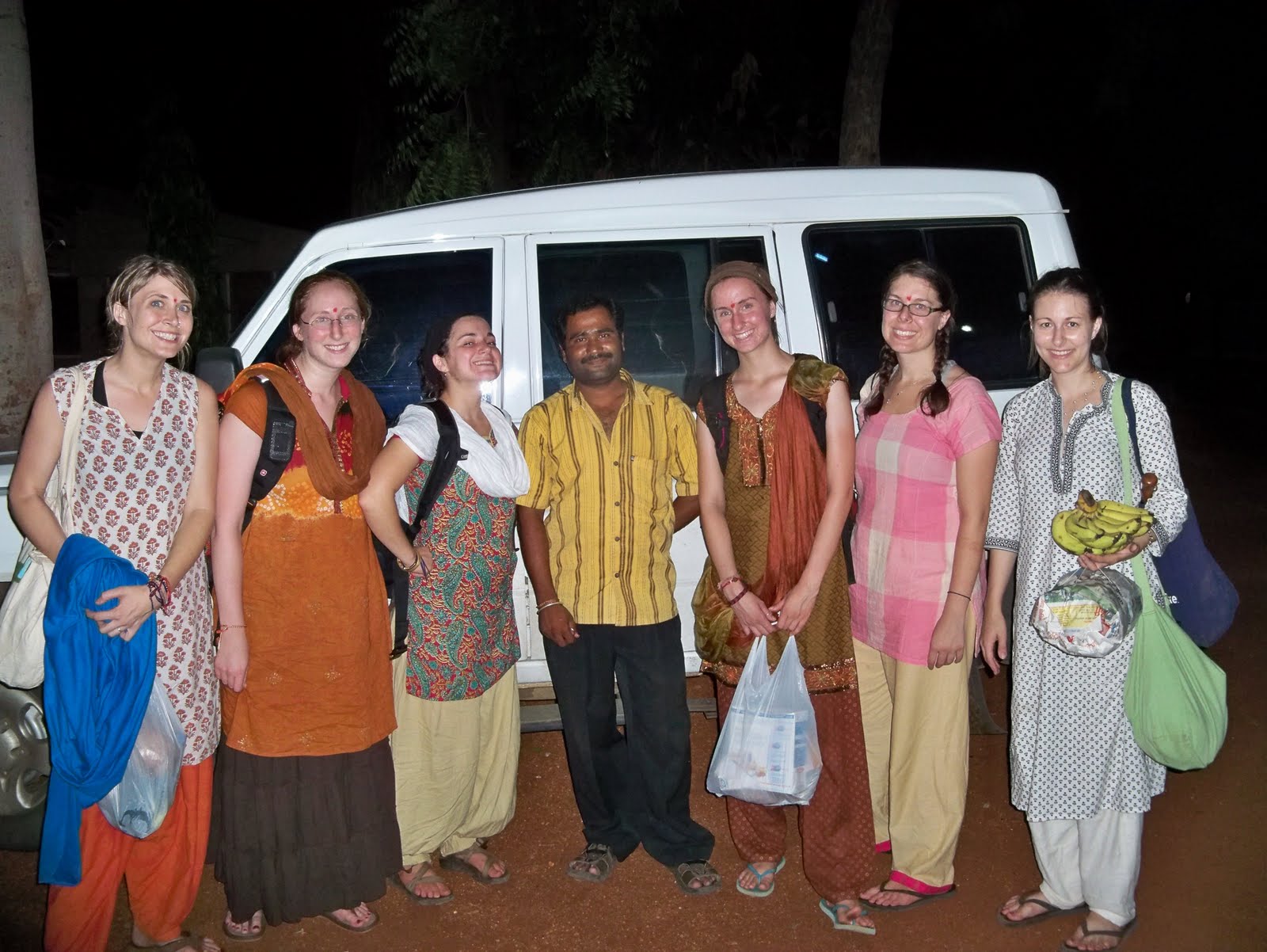
After Sevagram, we went to Chandrapur (the neighboring town to Gadchiroli) to visit another big temple (no photos taken there) and have a late lunch at another hotel restaurant. Back in Gadchiroli, we stopped at the ice cream store to finish off our July 4th celebration. Here is a picture of us with our driver for the day.

Thursday, July 8, 2010

Getting Down to Business

It was my perception that everyone started work on their projects slowly and built up the pace over the course of their internship. I had received a schedule on my first day at SEARCH that outlined my progress points and milestones and I thought I had it under control. I knew I would be presenting at one of the research meetings in the first week of July, but when I arrived in June, July seemed soooo far away. Further, I could have sworn it said something like July 6th or July 7th.

Well, on Thursday, a day that I spent mostly doing nothing and watching girls get their noses pierced, I realized at 4:30pm that I was supposed to present at the 8:30am research meeting the next day, July 2nd! Uh oh! At first I was going to make up some excuse like it was only my first full week and I was not prepared, but I did not think this would be appropriate. Besides, many of the other girls had to present in their first week or two here. So, I immediately snapped into work mode. Although I had not done much of the literature review that was supposed to be the first step in my project, I had already begun looking at the data and had put a lot of thought into the analysis and the output that I hoped to get.

I quickly started drafting up my powerpoint presentation. By prayer service I had about half of it done, and I was proud of myself for taking the work seriously. I talked with the other interns to get a good sense of what would be expected. Some said that since it was my first presentation, I should definitely present my literature review. I panicked because I had barely read the literature on my topic (smokeless tobacco consumption in pregnant women) and I was only going with prior knowledge. They advised downloading some articles before the internet cut out, and reviewing them the best I could. Some of the other girls told me not to worry so much about presenting the literature review, and to just focus on what I had done, and to at least present what my plan would be for the work that I had not yet completed. They all said that sometimes Dr. Bang could be very critical of the work presented, but it was all meant to be constructive.

That Thursday evening was probably the first time I felt professionally stressed at SEARCH. I was excited to be here and work on my project, but all of a sudden I felt like it had gotten the best of me. The presentation would be my first real interaction with Dr. Bang and I wanted him to think highly of me. I did not want it to show that I started preparing my presentation the afternoon before I was scheduled to give it. I used my time wisely for the rest of the evening. When the girls gathered for a movie night to watch Kung Fu Panda, I only stayed for part of it. I wanted to go to sleep early because I planned to wake up early and put some final touches on my presentation.

In the end, everything worked out wonderfully. I was proud of the powerpoint slides that I put together and I think I was able to explain them well and clearly. After my 15 minute presentation, Dr. Bang's first words were "Very good." He asked the room if there were any questions and there did not seem to be any major issues. Then Dr. Bang and Anand asked me six or seven questions between them and I was able to come up with a response to each of them. Although I was sorta half-guessing my answers, the point of the research meeting, or the journal club, is for the project to be a discussion. As long as you say something and do not sit there and look dumbfounded, you have done a good job. At one point I glanced across the room and Miriam gave me a thumbs up! At the conclusion of the meeting the other girls told me I had done a good job and that not all the presentations always go that well. This made me feel really good. I credit the intense methods courses at UNC for preparing me so well and helping me to appear as if I am a true epidemiologist.

Nose Piercing, No Thanks!

Nose piercing is very popular in India. Traditionally, the left nostril is pierced. According to some online research, the left side is chosen because it is the spot associated in Ayuvedra (Indian medicine) with the female reproductive organs, and the piercing is supposed to make childbirth easier and lessen period pain.

Miriam already has her nose pierced, but she had it done in Jerusalem, and it is on the right nostril. Kate and Brenna were considering having their noses pierced, and bought some jewelry earlier in their stay, in case they found a place that was able to do it hygienically.

Ama (Dr. Rani Bang) got word that some of the girls were interested in getting their noses pierced and arranged for her friend, the local goldsmith, to come to SEARCH and do it for whoever wanted it done. On last Thursday (7/1) afternoon, when the goldsmith came, we all marched over to the hospital to provide moral support as Kate got her nose pierced. By then, only she was certain that she wanted to do it. It was going to be done with a needle, not a piercing gun, and we were very much interested in watching this act of bravery!

Ama is very motherly and protective, always looking out for us. That is why she is called Ama by everyone at SEARCH. (Dr. Abhay Bang goes by Nyna). She was very excited to have her American interns get their noses pierced. Kate was the very first to go. She was nervous, but excited, and we all cheered her on. It went pretty quickly, and the goldsmith was able to fashion a decorative silver hoop with the metal he used to pierce the nose. I didn't get any pictures of the event, but we have some on the other girl's cameras.

After Kate, Sona sat down in the hot spot. Although she has lived in India her whole life she has never had her nose pierced and now seemed like the perfect opportunity. Bhagyashree, who does have her nose pierced, held her hand through the process.

When Sona was done, Ama started encouraging Brenna to get her nose pierced. At this point, Brenna was expressing that she no longer wanted it done. But Ama said, "Of course you do, why else would you have already bought jewelry for it in Chandrapur." As Brenna tried to resist, Ama put her arm around her shoulder and said "I'm your Ama, and your Ama knows you really want to do it." Kate started to help Brenna's case and ask her if she didn't want to do it because she truly did not want it anymore, or if she was just scared to do it. Ama replied, "She is just scared, I have seen this many times before." It was only because Brenna had expressed prior interest, that I was ok with the semi-pressuring coming from Ama. In the end, Brenna got her nose pierced as well and had an identical silver hoop.

I thought this was the end, but then Ama moved on to Marie. At this point, Amy ran out of the room. She no longer wanted to be around what she said was a very peer-pressured situation. I was more curious at watching the event, so I continued to stay. Marie said she had never thought about getting it done. Well she must have guts! Because in a matter of minutes, and Ama's smooth talking, Marie was getting her nose pierced! Halfway through the process, Miriam said to me "Aliza, if you don't want your nose pierced, I would leave now." I looked around the room. I was the only one left (Jessica had been working in the hospital this entire time and was not there) and I would surely be next in line for Ama's attention. I scooted out of there real fast!

In addition to never having desired a nose piercing, I knew that it would not be accepted by Ben or my family. Further, although Judaism has changed to accept body piercings, and in some societies even tattoos, I still wanted to adhere to traditional Jewish beliefs against piercings and tattoos. Even though Ama told Brenna she could remove it if she didn't like it, and I knew she would use this same line on me, I did not see the point of getting something that I was 100% sure I would remove once I was home. Therefore, I am glad that I left the room.

However, the four ladies that got their noses pierced that day look very lovely and I think they truly appreciate having had it done. They will have a great story to tell. Not only did they get their noses pierced in India, where nose piercing is most popular, but they had it done while holding hands with Dr. Rani Bang, who is an amazing woman and true pioneer in public health and womens' health.

Wednesday, July 7, 2010

The Typical Day

Now that I have written about the trips into Gadchiroli, to Bodli the rural village, and the Markanda temple, I will give a description of what the normal day is like at SEARCH. I am supposed to be doing an internship here and not sightseeing every other day.

For those of you worried that I am ten days behind the present day in my blogs, I will say that the next few entries are going to bring us up to speed as we flash forward through the typical day here at SEARCH.

The daily schedule:

6:15am Shramdan (group cleaning, only on Wednesdays and Saturdays)
8:00am Breakfast
8:30am Research Meetings (only on Friday and Saturdays)
1:00pm Lunch
6:45pm Prayer Service
8:00pm Dinner

Shramdan is group cleaning. It's not voluntary, but you can try to get away with missing it by staying in bed. However, they bang this large metal plate they have hung up in the center of campus, so that you are immediately woken up, and it is difficult to stay asleep after that. I was sorta excited at first because I don't mind cleaning, and I was under the impression that Shramdan would include all sorts of tasks. Really, the only chore to do is to take straw brooms and sweep the grounds and paths outside so they stay beautiful red sand and don't have leaves all over them. It's really boring and you can't help but think the whole time that you are sweeping the dirt outside. It does make all of SEARCH look really nice when we are done though.

Breakfast, Lunch, and Dinner are self-explanatory and I will have a post on the food in the future.

Research meetings are a chance for the research interns to present their progress and their results to Dr. Bang and Anand and the the others on the research team. You get assigned the weeks that you will go and it is mandatory that all the interns present while we are here. This is not that bad either, and it's very typical of any research lab.

In the evening, prayer service is also mandatory. Every evening follows the same structure. Everyone shows up between 6:45pm and 7pm while some meditational music is playing and you are expected to sit there and meditate and be quiet. Then, once everyone seems to have gathered, Anand, or one of his parents if they are there, starts the prayer. It is in Marathi. It sounds like one big song, but Sona told me it's actually five different prayers combined. It's non-denominational, but since it's in Marathi, I have only picked up some of the words here and there. After the prayer, people are invited to sing songs or discuss events during the day in front of the entire group. This portion can last anywhere from 5 minutes to 45 minutes. I have gone up in front of the group twice now. The first time was as an ensemble to sing a Jewish song last Friday in honor of Shabbat that Miriam led. The second time was this past Monday when they made Jessica and I get up and tell everyone about our field trip to Gandhi's ashram (future post). I really like when prayer service runs on the shorter side because we sit cross-legged on the floor and my feet fall asleep and then I get all fidgety.

In between meals and mandatory events, the rest of the time is your own, when you expected to work on your research project. However, if you'd like to take a nap, or go for a stroll, that is ok too, as long as you get your work done. I spend most of those hours in either the library or the research building and I probably spend only half of the time on my project. The rest I spend reading emails, surfing the web, and writing on the blog. The internet connection can be very slow so sometimes it takes a while just to look up one thing online. Overall, the atmosphere is very relaxed. I really enjoy it. The work that SEARCH does is very good, but it never feels stressful. This is the first summer in a long time that I have been able to feel like I am taking a long vacation, with just enough work to keep my mind stimulated.

One other thing that I wanted to mention about the typical day here is that the power always goes out because all the energy comes from generators and sometimes the weather or the overuse causes it to short. The power must cut out at least five times every day. The good thing is that it always comes back a few seconds later. There has only been one time that it stayed out for more than five minutes. It is a good thing that the power always comes back on because I would feel really uncomfortable in the evenings when it is dark. Knowing that it is going to come back on in a few seconds makes it not so scary. In addition, I always have my head lamp with me in the evenings, so I am never that long in the dark.

Pictures of my room: I started at the door and panned left around the room.


Doorway. You can see the blanket I use to seal the bottom of the door at night.

My "beauty parlor" bench. I keep my most basic toiletries and water up on the bench. This is all I had with me when I arrived at SEARCH. Now, I have a few more items placed up there. The white and blue container is a small water jug.

The large window and my bed. The geckos love love love to hang out on this window, fortunately on the other side of the screen. For the first four days I had a table under the window, but SEARCH ended up taking it to use for another purpose.

My bed, the other bed, and the green metal armoire. Now that they took the table away from me, I use the other bed to keep my stuff off the floor. Rushina is coming tomorrow and will be my roommate, so I have to come up with another solution.

Another shot of my bed. I sleep with the blanket that is folded at the end. I am currently using the pillows from both beds, so again I will have to find another one tomorrow when Rushina comes.

A shot of the mattress. You can see it's more like a bed pad. I've become quite used to it though, and I have decided I like firm beds instead of soft beds. I think I sleep better.

A picture of my things neatly arranged on the other bed. This is all I had with me when I first arrived at SEARCH in addition to the few toiletries on the bench. The blue bag has all my granola bars. Inside my backpack I had important papers, a book and a journal, my camera, my cell phone, my laptop, ben's ipod, adapters, and chargers. Now that my suitcase has arrived, I keep it on the floor under the large window.

When my suitcase arrived I arranged all my toiletries on the middle shelf of the armoire. I suppose I could empty out all my clothes into it too, but I'm paranoid that a bug will come, and that they are safer inside my suitcase. When Rushina comes we will probably figure out a better solution.

Back to the door. I have some nice hooks to hang up my purse and my scarves. When my suitcase hadn't arrive I started using the scarves as towels. This works out nicely because the air here is very humid and the normal bath towels would take forever to dry. Even with my suitcase, I still use the scarves as towels because they dry quickly and the air dries me off pretty quickly too, so they are all I need.

Monday, July 5, 2010

Sunday in Markanda

Sunday is our day off and the usual plan is to go into Gadchiroli for shopping and eating the food we can't get at SEARCH like eggs, ice cream, and chocolate. We've been very fortunate to plan some field trips in addition to our stops in Gadchiroli. On my first Sunday here, Sona led us on a trip to Markanda, which is an old temple within a village outside of Gadchiroli. I was especially lucky because I was going on my third outing in the five days I had been at SEARCH!

The temple itself is actually made up of many smaller temples with a large central temple. Each temple houses a god in the form of a statue. Sometimes the statue looks like a person, sometimes it is an animal, sometimes it is something more inanimate. Sona told us that at Markanda, every temple was for Shiva, a Hindu god, just in different forms. In some of the shrines Shiva is represented as the god of death and in others the conqueror of death. (I hope I'm getting this right!) What I gathered from the trip was at a very superficial level, and I'm sure there is a lot more meaning behind the temple and the religion of Hinduism. I was under the impression that Hinduism is polytheistic, but upon reading some material to make sure nothing I said here was completely wrong, I learned that Hinduism can actually be monotheistic. Perhaps one god manifesting itself in many ways? I haven't retained much since 9th grade global history. It's all confusing to me, and if I truly want to understand it I will have to read up on it.


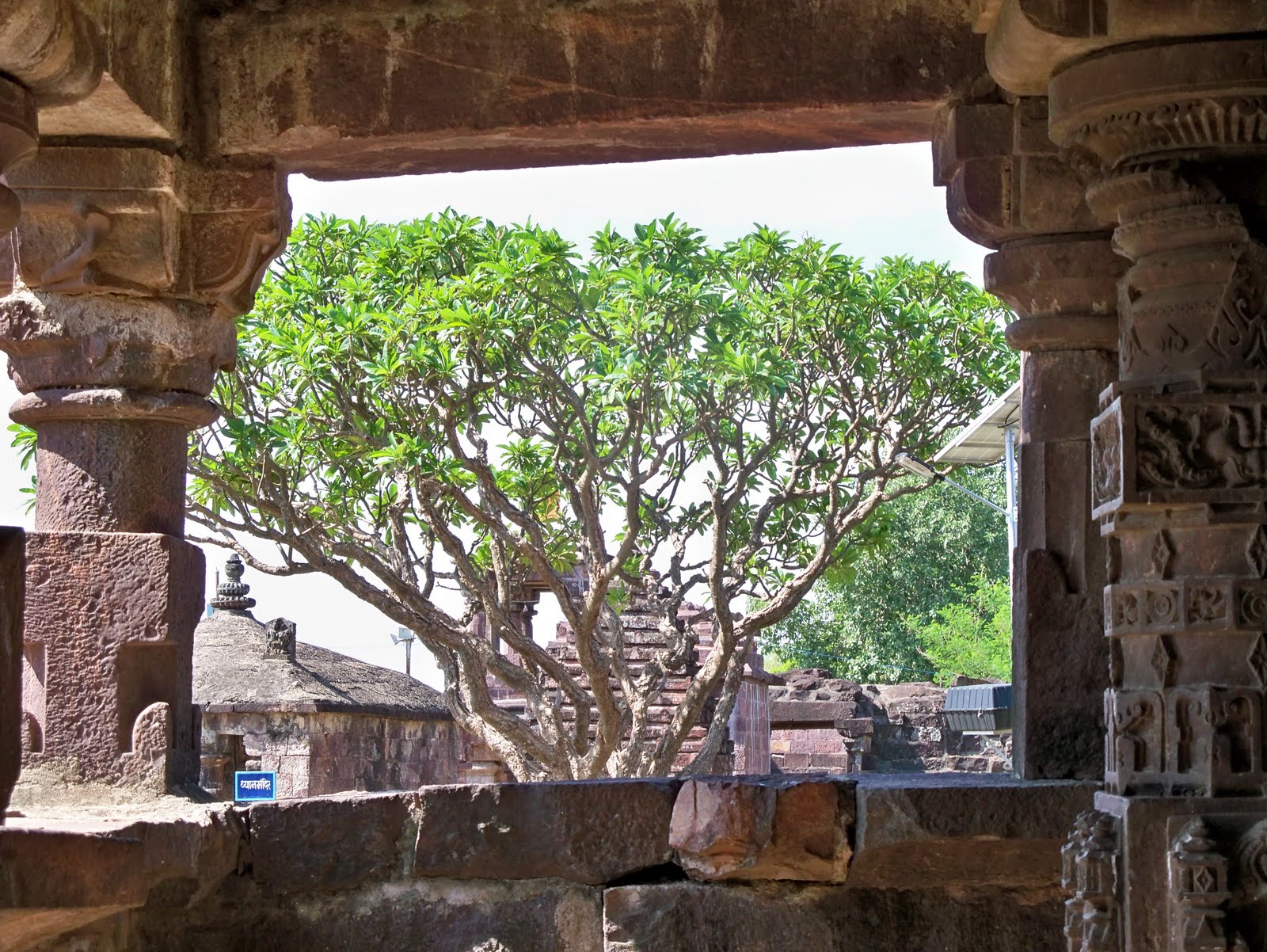
View of a beautiful tree, as seen through the columns of the temple. After our visit of the grounds we sat under this tree to snack on bananas and masala munchies (like cheetos, except instead of cheese flavor, it's Indian spice flavor). Our group stayed under the tree until we felt like we were becoming more of the attraction than the temple itself.

This is an image of the top of the main temple. The stone work is very intricate. (You can always click on the photos within the blog to enlarge them.) Over 250 years ago, lightening struck the top of this temple and it partially collapsed. I'm not actually sure if this image captures that side of the temple, but Sona kept pointing up trying to show us where.

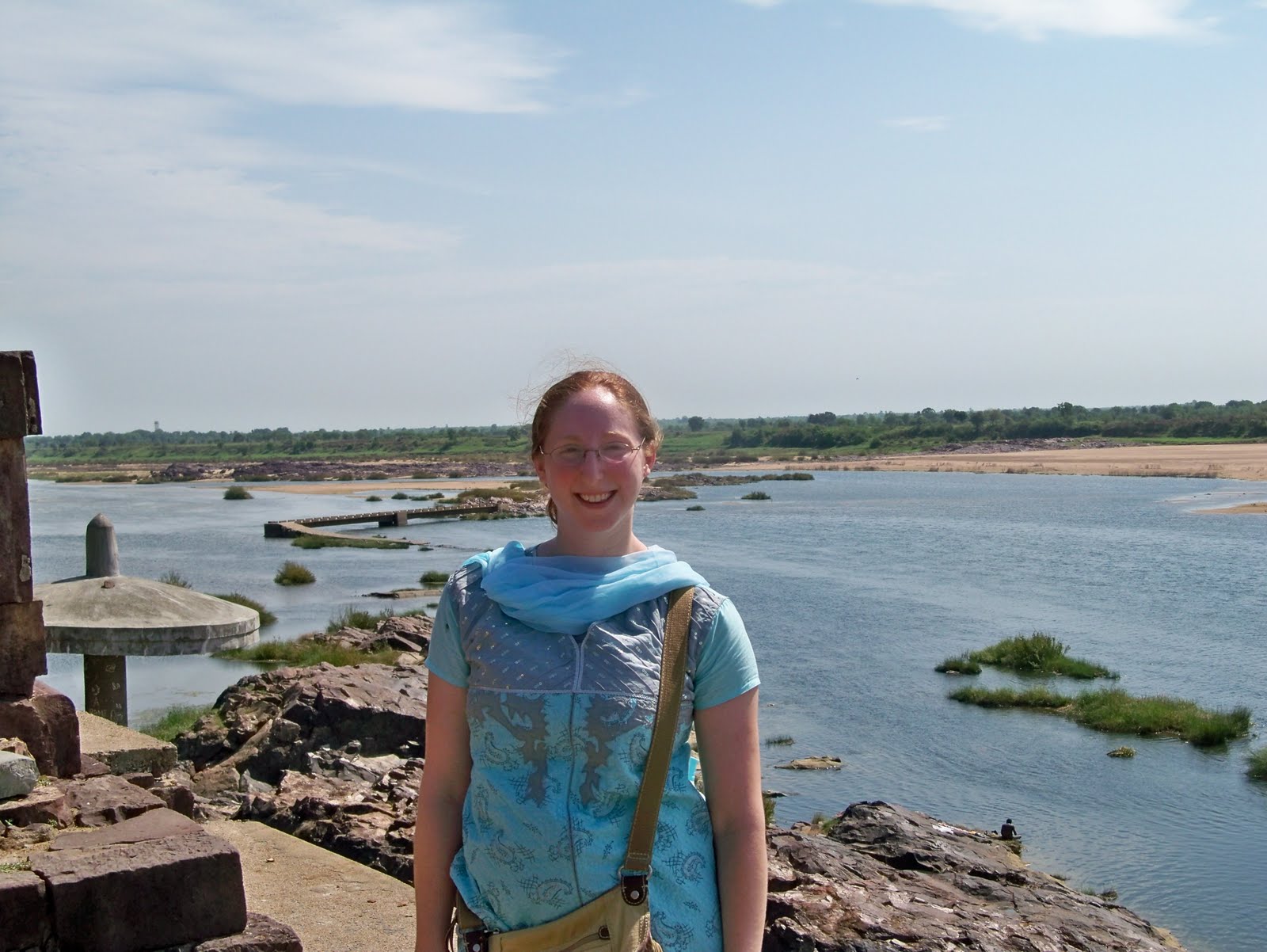
The temple is situated on the Vainganga river, which is an "auspicious" river because it changes directions, flowing both north and south. Here, the women from the Markanda village are washing their clothes. Many things in India are considered "auspicious", meaning promising success or favored by fortune. It is an English word that has infiltrated the Marathi and Hindu languages, and I've heard it used more here in the last two weeks than during the rest of my entire life.

Me with a view of the river.

Beautiful old doors along one wall of the temple grounds.

The group. From left to right: Kate, Amy, me, Miriam, Brenna, Bhagyashree, Marie, and Jessica.

Me standing in the doorway of a side entrance to the courtyard of temples. You can see the large temple over my right shoulder. I had my scarf tied on my head because my hair kept blowing in my face. I think I ended up looking Greek instead of Indian.


After visiting Markanda, we drove back towards Gadchiroli. One of the highlights of the day is that we took a detour to go pick up my suitcase!!! I was very excited to personally pick it up from the station where the airline dropped it off (they refused to come all the way to SEARCH), with all the other girls in tow. We were able to use the van we had for the day to pick up the bag, although it would mean cramming even more into our limited space. We already had 11 people in the van! I am very thankful to the others for allowing us to do this. It felt like a celebration to retrieve the lost suitcase! Oddly enough, the official station where the suitcase was being held was a gas station. Don't ask me why. Anyway, there was a very nice man there who had me sign some paperwork and unwrap the plastic wrap that covered my bag. Later in the evening when we returned to SEARCH I finally opened the bag and was very happy to find that nothing was missing, broken, ruined or melted. I was very happy to finally have my bag and to know that even the sunblock and insect repellent were still in good shape, which meant that the extra batteries and camera battery I had stored in there were also going to be fine.

After picking up the suitcase we went to Gadchiroli where we had a nice lunch at the same restaurant we had eaten at on Thursday. The restaurant is part of the Hotel Rashika. Hotels are often the fanciest places in town, but the standards are very different here. After our lunch we went shopping. I had nothing in particular to buy this time so I went with some of the other girls to look at fabrics.

Shopping for women's clothes is very very different in India, especially in the areas outside the cities where you will not find Western outlets. Since the sari and salwar kameez are pretty much the only style of clothing worn, women here will go to a fabric store where they sit and choose exactly the fabric they want, get measured, and have their new sari or salwar kameez custom made. The fabric stores often have plushy flooring because women, sometimes with their husbands, will come and sit down for hours mulling over the options. (Shoes are always left at the door, so as not to track in dirt). It seems like so much fun! Imagine if, instead of shopping malls with chain stores, all of our shopping was done in this manner. One of the stores we visited even served us chai tea because it was tea time while we were there. Here are some pictures of one of the fabric stores we visited:


Good Surprise, Bad Surprise

There isn't much to say about Saturday (6/26).

I had a good surprise, which was that people came to clean the bathrooms and our bedrooms. The other girls had mentioned that during our morning chores on Wednesday and Saturday we wouldn't have to worry about most things because people come to clean and change the toilet paper in the bathrooms, but I didn't realize the extent of it. They wiped down all the toilets and sinks (which get really buggy), and they hose down the floors, and they replenish the toilet paper, and they put up air fresheners. Our bathroom was "sparkling clean", in relative terms. This made me happy because I realized I arrived at SEARCH during probably the worst days in terms of bathroom cleanliness, but that really it was usually going to be in better condition.

The bad surprise I had on that Saturday was that my suitcase did not come. I sorta expected it to not come as early as Thursday, but I had hoped for Friday. When it wasn't coming on Friday, SEARCH told me they would go get it on Saturday. When Saturday afternoon came, they told me we wouldn't get it until Sunday. I started to worry that every day would become just one more day, and I think I panicked that I would never get it. I felt like I had no control over the situation. So I got really moody Saturday afternoon and didn't do much work on my first real work day. (The work week is Monday-Saturday in India).

The only other thing that happened, as I mentioned in an earlier post, is that I saw my first snake while alone, and I didn't freak out. I was happy about that too.

Saturday, July 3, 2010

Bodli: The Rural Village in Words

On Friday (6/25) we attempted to go back to Bodli to visit the village health worker, Anjana, and observe her as she did an infant assessment and follow-up.

The post below shows some of the pictures I took on our trip. I had an amazing time. To begin with, Anjana was incredible! She reflects the dozens of women that SEARCH has trained to work as village health workers as part of the Home-Based Maternal, Newborn, and Child Care program. These women are usually uneducated or have only reached a certain level of schooling. Yet, they are given the responsibility to record and track all women of reproductive age in the village, all missed periods of all the women, and all pregnancies (four months without a period). Once a woman is designated as pregnant, she receives health education and antenatal care from the village health worker. The village health worker is also present at the majority of deliveries and is trained to react in trauma situations such as asphyxia , sepsis, and hypothermia of the newborn. At the same time, she is responsible for recording critical data such as the birth weight and the condition of the mother. She then follows up with the mother and newborn every day for an entire week and continues to make weekly and monthly visits during which she conducts interviews interwoven with health messages for the mother. This is a lot for one woman to take on!

I was overwhelmed with gratitude for being given the chance to observe the operations of the program. In a self-centered way, I have wanted to witness global public health in action for a very long time. At school I have seen hundreds of photos taken on study abroad and internship experiences, even being in charge of the global health exhibit at the UNC School of Global Public Health this past year. For many years I have desired to go on a trip like this, and to finally be sitting in a rural village, at the home of a community health worker, felt very genuine and fulfilling. Now I was able to take my own photos, and I was able to feel firsthand what it is like to be in the field.

One of my immediate reactions to the sights and sounds of the village was one of culture shock. It was hard for me to imagine that this wasn't just make pretend village, like one would see at Disney or Plymouth Plantation. This was an actual village, where people lived and worked. The conditions are quite different from the ones we are accustomed to. Here, it is normal for livestock to live outside your home, to walk barefoot down the streets, to collect water at one central location for all the homes. I wondered how people could live this way. Inside the homes, there is not wall-to-wall carpet, or dry wall, or fancy furniture, or electronics. The homes are made of mud, clay, cement, and tile. One is lucky if the walls have any color or paintings on them. There are minimal decorations. The only furniture is usually some cot-like beds, some plastic chairs, perhaps a stool, some woven mats on the floor, and maybe a table. The walls are carved out with shelves where you can see some items like a hair comb, a bottle of medication, some silverware. You can tell that these people care for the little material possessions that they have.

Since we were observing an infant assessment and talking a lot about babies, families, and children, I had a very "Western" thought, like "Why do these families keep having children, if these are the conditions they are raised in?" Immediately though I realized that I was trying to force my perceptions of happiness and life into the life of the village residents. For them, the village was community, family, home, pride, happiness, resiliency, etc. Although I may not be used to walking with bare feet on a cement and dirt floor in my home and sleeping on cots in one room with the rest of my family, this was the way of living that these people had always known. I kept wanting to view the lives of the villagers as being filled with hardships, but none of the villagers seemed to be upset or unhappy. And while what is considered a luxury here is very different from back home, these people have the right to have children and sustain their futures just like anybody else.

This cascade of thoughts made me realize how fortunate I was, not just to have the life I did back home, but to be in the presence of the villagers and learn from them. They have so little in the way of material possessions, and one bad storm that kills their crop or an illness in the family can mean the difference between food and hunger, but they are filled with strength and they carry on.

I have tried the best I can to describe my time in Bodli, although I fear I have come off sounding cliche. I am saying the things that anyone would say when visiting a third world country, a developing nation, a rural village in India. Beyond the words that I write here, I cannot fully express or explain the emotions I had during our rural village field trip. On the bus ride home, Miriam and I discussed these thoughts. At 19, Miriam has already lived in Africa and Israel, and she has had moments like this before. We talked about how it will be hard to describe our experience to others back home because as humans, we often describe through comparison, and put things in relative terms. We describe the rural village in reference to our own homes. But, it is not enough to compare and contrast our way of life with theirs. We share the desire to be part of a community, love, sustain our health, have a family, and feed, shelter, and take care of our loved ones. Beyond these commonalities, Bodli, and the many other rural villages like it, are separate and beautiful from our world.